
Pros and Cons of Chiropractic Medicine
X

Functional Aging
Specialists

Find Out More
Your Personal Best Training Studio
Doddridge Plaza
3765 S. Alameda, Ste 102
Corpus Christi, TX 78411
(361) 857-5087 info@ypbtrainingstudio.com
MENU
newsletter
  1. Pros and Cons of Chiropractic Medicine

    Chiropractic medicine focuses on musculoskeletal and nervous system disorders. Care is directed mainly at reducing back, neck and joint pain, as well as headaches.  Chiropractic medicine offers numerous benefits to patients, including drug-free treatment for

    chronic and acute pain that is both safe and effective. It also focuses on hands-on therapeutic procedures, rehabilitative exercises, and nutritional and lifestyle changes. Most ailments are treated with a procedure called spinal manipulation, which helps to restore joint mobility through the use of controlled forced directed at hypo-mobile joints. Effective manipulation relieves pain, decreases muscle tension, and allows the healing of damaged tissues to take place.

    The benefits of chiropractic care have been experienced by many.  Some benefits extend beyond musculoskeletal and different people who suffer from these illnesses experience varying results as well:

    • For pregnant women, they are able to deliver much easier.
    • For babies, they have improved developmental abilities and prevent the possibility of acquiring scoliosis.
    • For kids, it helps prevent asthma, ear infection, bedwetting, among other things.
    • For adults, they are able to generate more energy and increase productivity.
    • Better balance and less injury is attained by senior citizens.

    Meanwhile, overall results and benefits reported from patients who’ve undergone chiropractic care includes the following:

    • Boost in the functions of the immune and nervous system.
    • Patients attain improved vitality.
    • Breathing becomes easier.
    • Great digestive functions.
    • flawless vision.
    • Improved overall health.

    There are some cons regarding chiropractic care, as well.   In some cases, various degrees of discomfort and/or stiffness may follow a chiropractic adjustment, but this discomfort typically resolves within one to two days. While not every health insurance plan currently offers coverage for chiropractic care, most  larger insurance providers do cover all or some of the expenses related to treatment by a doctor of chiropractic medicine. However, because chiropractic treatment often involves multiple office visits, costs can quickly add up for those without insurance coverage. Frequent trips to the doctor’s office may be inconvenient for many people, especially for those dealing with acute pain or another disability, and chiropractic care is not suitable for all people. People with certain medical conditions, such as acute gout, bone cancer, excessive osteoporosis or existing bone or joint fractures may not be suitable candidates for spinal manipulation.

    Several different modalities are used during chiropractic care.  One modality that is used as part of chiropractic therapy is electric stimulation.  The primary use of this tool is for muscle relaxation and pain relief.

    The treatment improves healing to the area and causes the muscles to relax, releases chemical pain relievers and temporarily confuses the nervous system so that it is not able to transmit pain signals as well.  In essence you get temporary pain relief and improved healing.

    Chiropractic care has been found to be quite successful for many people.   While not a “cure-all”,  it can definitely bring relief for many patients seeking  an alternative to traditional medicine or drug therapy. We recently had the opportunity to interview  Armadillo Sports Chiropractic’s Dr. Chad Peters. We’d like to share our interview with you. Find it here, enjoy!

    Read more: Pros and Cons of Chiropractic Medicine & here 

  2. Caffeine and Protein in a Drink? Does It Possess Any Benefits for Athletes?

    Most of us have an understanding of our body’s need for protein, but what about caffeine? Since YPB has incorporated the new coffee/protein drink “Click” there has been some questions regarding the use of caffeine and its effects.   Research from Vanderbilt University has found:

    Click Protein Vanilla Latte

    Caffeine has many specific benefits for different types of athletes.  Though much of the research on caffeine in athletics is inconclusive, there are many athletes that believe the substance can enhance their physical as well as mental performance.  It is supposed that caffeine can improve the athlete’s endurance in sports where long-term stamina is needed.  These sports include cycling, running, and even soccer.  In an experiment to study the effects of caffeine as an ergogenic aid, 6 regular caffeine users were monitored while they exercised until exhaustion.  During this double blind, placebo test, the athletes were given pills an hour before the exercise trial.  The results were that those who received caffeine before the exercise performed more efficiently than those who received the placebo. (Graham, 1998)  This shows the importance of caffeine in endurance sports such as cycling, running, and soccer which require a great deal of physical stamina in order to compete successfully.  Studies also show that caffeine has very little effect on athletes requiring quick bursts of energy such as sprinters and swimmers.  Also caffeine has been known to decrease fatigue in athletes, which plays a physical as well as psychological role in the performance of an athlete.

    As far as sports performance, here are a few tips that may prove useful for athletes to maximize their full potential:  It is important that the athlete refrains from caffeine use 3-4 days before their competition.  This allows for the tolerance levels of caffeine to decrease, thus making the body susceptible to caffeine when consumed.  Also it is important for athletes to understand their caffeine limits.  If you have never used caffeine for sporting enhancement, then you are unfamiliar with caffeine’s affects on your body.  Make sure that you have used caffeine in a variety of training conditions to understand your limitations.  Also it is advantageous to ingest caffeine 2-3 hours before competition to ensure a peak of performance.  Studies have shown that it takes several hours for caffeine to enter the body and exploit the use of fat, thus storing glycogen for endurance.  All of these tips are essential in making the most of caffeine’s benefits in athletics.

    While the idea of combining caffeine and protein is quite appealing, one must also recognize the fact that protein takes one to two hours to digest, so it may not be the best choice, pre-workout, as it can cause nausea.   So, go ahead and have your morning coffee and enjoy the caffeine effect; however,  if you decide to make that Click Mocha or Latte , do so after  your workout vs. before.

  3. Are Your Children or Grandchildren Educated About Healthy Living?

    With Corpus Christi previously nominated as one of the fattest cities in America, it is important that we educate our kids about healthy living.  Education is paramount if we are to help the next generation make healthier eating and lifestyle decisions.  Use the 10 tips below to help educate your children about making healthier choices.  Give them the link below and ask them to test their knowledge.

    1. Food is Fun… Enjoy your food

    Sharing a meal with family and friends at home or at school is a great way to enjoy food. It is fun to see other people’s choice of food – what sandwich fillings do others have? Have you tried having a different filling every day? Check out your lunch box or dinner plate. How many different kinds of fruit and vegetables can you spot?

    2. Breakfast is a very important meal

    Our bodies always need energy, and after a night’s sleep, energy levels are low. Cars, buses and trains cannot run without fuel. So, whether you are off to school, or out and about at the weekend, start the day with breakfast. Plenty of carbohydrates is just the ticket: try cereal with semi-skimmed milk, fruit or yoghurt, toast or bread, perhaps with lean meats.

    3. Eat lots of different foods every day, variety is the recipe for health

    You need over 40 different kinds of vitamins and minerals every day for good health. Since there is no single food that contains them all, it is important to balance your daily choices. In fact there are no good or bad foods, so you do not need to miss out on the foods you enjoy. The best way to make sure you get the right balance is to eat a wide variety of foods each day.

    4. Which group would you tip for the top? Base your food on carbohydrates

    Many people don’t eat enough carbohydrate foods, such as cereals, rice, pasta, potatoes and bread. At least half the calories in your diet should come from these foods, so it is a good idea to include at least one of these at every meal. Try whole-grain bread, pasta and other cereals to give you extra fiber. Have you tried baking your own bread? It’s good fun and smells wonderful!

    5. Gimme five! Eat fruits and vegetables with each meal and as tasty snacks!

    Fruits and vegetables are among the most important foods for giving us enough vitamins, minerals and fiber. We should all try to eat 6-10 servings a day. For example, a glass of fruit juice at breakfast, perhaps an apple and banana as snacks and three vegetables at meal times then you have already reached your total. How many different kinds can you spot in the supermarket?  Why not try some new ones?

    6. Fat facts. Too much saturated fat is not good for your health

    Eating too many of those tasty, fatty foods (such as butter, spreads, fried meats and sausages, pies and pastries) might not always be so good for your body. So remember, a big helping of potatoes, but go easy on the butter. Although we need some fats to get all the nutrients we need, it is better for our health if we don’t eat too much of these foods and get knocked off balance. So, if you have a high-fat lunch, choose a low-fat dinner.

    7. Snack attack! Eat regularly and choose a variety of snacks

    Even if you eat regular meals during the day, there will still be times in between that you feel hungry, especially if you have been very physically active. Snacks can fill the gap, but should not be eaten in place of meals, only as an extra. There are lots of different snacks available. Your choice may be a yogurt,  nuts and other packet snacks. On other occasions, you may prefer a sandwich, some fresh or dried fruits, or perhaps sticks of vegetables like carrots and celery. Whichever snack you enjoy, remember it is always good to include a variety of different types to keep things in balance.

    8. Quench your thirst. Drink plenty of liquids

    Did you know that more than half of your weight is just water? So as well as giving your body all the food it needs each day to keep healthy, you need at least 5 glasses of liquids a day. It is particularly important if the weather is very hot or if you have done lots of exercise, to have plenty to drink to prevent dehydration. Usually – but not always – your body will tell you this, by making you feel thirsty. Plain tap water is great of course, but bottled water, fruit juices, tea milk and so on, can all be okay too.

    9. Care for those teeth! Brush your teeth at least twice a day

    Brush your teeth at least twice a day. Eating foods high in sugar or starches too often during the day can play a part in tooth decay. So don’t nibble foods and sip drinks all day long! However, the best way to keep a nice smile is to brush your teeth twice a day with a fluoride toothpaste. Also, after brushing your teeth at bedtime, don’t eat any food, or drink anything but water!

    10. Get moving! Be active every day

    Just like a bike may become rusty if it is not used for some time, our muscles and bones need to be kept moving too. Activity is needed to keep your heart healthy and your bones strong. It can also be good fun. Try to include some form of activity every day: it may be just walking to school and running up the stairs. However, games like skipping and football at break times are good for giving the body a workout. Swimming is a particularly good sport for keeping you healthy.

    Take this short trivia quiz that will help educate and dispel some of the myths that kids have about nutrition.

  4. CLICK Spicy Mocha

    Looking for ways to use that new “Click”?  Here are a couple ideas:

    CLICK Spicy Mocha
    • 4 oz. of Non-fat Milk

    • 8 oz. of Water
    • 1/2 Tsp. Cinnamon
    • 1/8 Tsp. Cayenne Pepper (or more if you like a kick!)
    • 2 scoops of CLICK Espresso Protein Drink Mocha Flavor
    • Squirt of Sugar Free Whipped Cream

    Pour 4 oz. of non-fat milk into a shaker cup. Add 1 teaspoon of cinnamon and 1/8 teaspoon of cayenne pepper. Shake to blend spices with milk. Add 8 oz. of water to shaker cup, top with 2 scoops of CLICK, seal and shake.

    To make CLICK hot, pour into large microwave cup. Heat in microwave for one minute. Remove from microwave and stir with spoon. Reheat for 30-45 seconds to desired temperature. Top with a squirt of sugar free whipped cream. Ooh la la and ohhhhhh sooooo good!!!

    Or try “Click” with coconut water.

  5. Menopause and Spontaneous Exercise

    As we women age, most of us will inevitably enter into a new phase of life.  Menopause.  Ahhhh….Some would define menopause as “the end of menses”.  Others, “the change”.  One client described it a bit more colorfully.  She called it her “personal summer” while she was having a major hot flash!  Regardless of what word you use to describe it, menopause is real and has definite effects on the female body.  Besides the hot flashes, loss of libido and the threat of osteoporosis looming ahead, the most common complaint we hear at the studio is the sudden weight gain. Some feel it’s inevitable.  A loss of muscle mass and an increase in abdominal fat are common at the time of menopause; however it DOES NOT have to be a given that you WILL gain an extra 10 or 20 pounds.  Although common-not absolute!  If you remain active and continue with strength training, regular cardiovascular training and modify your eating habits, you CAN maintain your weight.  A major reason so many women DO gain weight is that they become more sedentary.  A sedentary lifestyle is conducive to muscle loss. With muscle loss comes a decrease resting metabolic rate.  Also, during the cessation of menses, women burn about 40-70 less calories per day, due to the declining estrogen levels. Oftentimes, calorie intake is increased.  Studies show that women eat more calories as estrogen declines and that we crave more fat and sugar and less nutritious, more satisfying foods that have protein and fiber. The amount of calories expended must be equal to the amount of calories taken in if we want to maintain our weight.  A simple mathematical fact.

    This exact question was posed to the panel of experts we spoke with while at the IDEA Fitness Convention in San Diego.  “What can menopausal women do to combat weight gain?”   With the obvious mentioned above, it was also stressed that during this phase of a woman’s life, spontaneous exercise is just what the doctor ordered.  Spontaneous exercise is any type of exercise that you do that is not necessarily planned.  ie:  Take a stroll around the mall in between each store you stop in, do lunges or squats during a t.v. commercial or park further away from your car and walk the few extra steps.   You get the idea.  Spontaneity! What a great idea….easy, cheap and very doable at an age where we all don’t need one more planned activity on our plate.  So get out there and burn off those extra calories.  Remember, you CAN maintain your weight during this phase of your life.  It’s a new chapter, so keep your shape and enjoy your life!


  6. Lose Weight Fast

    Lose Weight Fast

    Your Body’s  Defense Mechanism Against Dieting for Starvation

    By Terry Cobb- CPT, CES

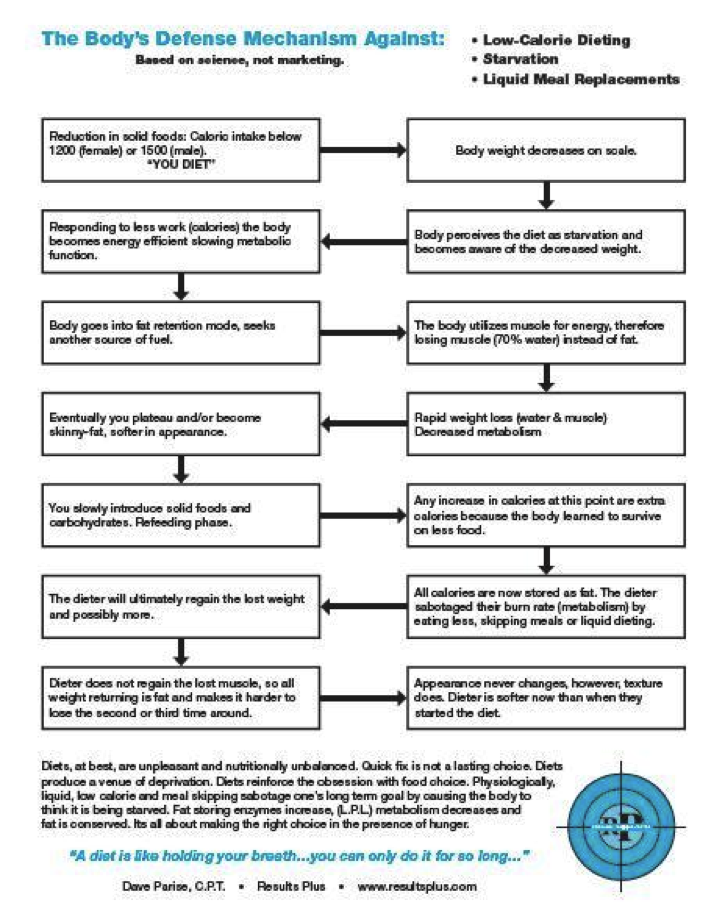
    Do you have a special event like a class reunion or vacation that you’ve been looking forward to for some time, but wish you were a few pounds lighter?  The event is three or four weeks away and you realize you still have those last few nagging pounds you weren’t able to take off.  This is often the time some people decide to “crash diet” and lose the weight as quickly as possible. But at what expense are these pounds costing us? The diagram below gives us a realistic look at what happens to our bodies as they go into a quick defensive mode to preserve and protect our health:

    Restricting calories or limiting yourself to a range of food can equal deprivation and missing out on important nutrients your body needs.   So count the cost first, before you begin that crash diet.  Are you willing to pay such a high price?  Your body was designed to take care of you long term.  Long term weight loss requires lifelong dietary changes.  So remember, small changes over a long period of time equals success.  It will ultimately come from the adoption of a new lifestyle, rather than a fashionable diet.


Your Personal Best Location
Your Personal Best Training Studio
Doddridge Plaza
3765 S. Alameda, Ste 102
Corpus Christi, TX 78411
(361) 857-5087 info@ypbtrainingstudio.com