
Hits and Myths About Spot Reduction
X

Functional Aging
Specialists

Find Out More
Your Personal Best Training Studio
Doddridge Plaza
3765 S. Alameda, Ste 102
Corpus Christi, TX 78411
(361) 857-5087 info@ypbtrainingstudio.com
MENU
newsletter
  1. Hits and Myths About Spot Reduction

    With our temperatures warming up the past few weeks, there has been a lot of talk around the studio from our clients about wanting to “get rid of the Jiggle” around the triceps, abdomen and upper chest area-near the shoulder. Clients are asking to “target” these troublesome areas as they don their summer attire-shorts, tank tops and bikinis. This is frequently referred to as “spot reduction”.

    Spot reduction is simply the idea that if you work a specific muscle group you will decrease the amount of fat in that area. The most common example of this is people focus on abdominal exercises in an effort to lose weight in their stomach area and get those 6-pack abs.

    In reality, there is no such thing as spot reduction. You will never attain a flat stomach just by performing abdominal exercises nor firm the chest and arms by weight training. The reason for this is simple: a muscle does not own the fat that surrounds it. Sit-ups or crunches for example, will definitely strengthen your abdominal muscles, but ab work alone will not get rid of the layer of fat that is covering the muscles. To lose fat anywhere on your body you need to create a caloric deficit through either a proper diet, exercise, or a combination of both-which we highly recommend. The only thing you need to do in the end, to improve the appearance of those trouble spots is to diet and exercise. Strength training helps you build a solid base of muscle, and that can help you look trimmer. But don’t neglect regular aerobic exercise and attention to your calorie intake, too. Your trouble spots might be less troubling if you build and tone your muscles … but not if they’re hidden under a layer of body fat .

    So why is it when someone loses weight, you see their stomach fat decrease or their arms tone into arms like Kelly Rippa’s? Yours look different. In short, everyone has their own unique body fat distribution. Some might carry it like saddlebags on the side of the hips, or have a stubborn spot on the belly. When these folks lose weight, it may appear that they’re actually spot reducing – but it’s just that they’re losing from those areas where their fat happens to be. If you look at how people’s bodies change with weight loss, what really happens is that they pretty much stay the same shape – they just get smaller.

    Men and women do have different issues when it comes to their trouble spots. Due to hormonal differences, women – at least before menopause – tend to store their fat in the hips and thighs, while men tend to gain weight around the middle. And men naturally carry less total fat than women do. With less fat overall – and most of it around the middle – it’s no wonder that men seem to have an easier time achieving washboard abs than women do. But spot reduction, it’s not.

    So to combat those trouble areas, continue exercising and limit your calories to the right amount for YOU and remember : Fat is not a moral problem. It’s an oral problem.

    Read facts written by MD: http://blogs.webmd.com/pamela-peeke-md/2012/03/hits-and-myths-about-spot-reducing.html


  2. Turkey Burger

    Hungry for a burger, but don’t want all the fat and calories?  Try a turkey burger.  I like to use my George Foreman Grill.  I usually just cook for myself, and this little grill is a great alternative to getting out my big grill for just one burger.  One serving of this little burger contains a whopping 21 grams of protein. (without the bun or cheese added)

    Ingredients:

    • 1 lb. Ground Turkey or 4 Frozen turkey patties-to serve 4
    • 1 Whole wheat Kaiser or hamburger bun
    • Light cheddar cheese
    • Lettuce
    • Tomato
    • Red Onion
    • Light Olive Oil mayonnaise
    • Dill relish
  3. Midnight Fudge Cake


    Midnight Fudge Cake

    We all need a little indulgence now and again to keep things balanced. With this recipe you can have your cake and eat it, too!  This recipe makeover replaces the key ingredients with healthy substitutes so as to cut calories and fat without sacrificing flavor. The unsweetened cocoa in this recipe adds an antioxidant kick that will satisfy your chocolate cravings and help chase away oxidative stress.

    Serve with a fruit topping instead of the frosting to save some calories, or just go for it!

    Ingredients:

    1 cup Sugar In The Raw® (Turbinado sugar)

    2 large eggs

    2 (2.5-ounce) containers of “baby food” prunes

    1¼ cup nonfat milk

    1 teaspoon (tsp) vanilla

    1 tsp baking soda

    2 cups oat flour

    1 tsp baking powder

    1 tablespoon (tbs) Stevia with fiber

    2/3 cup unsweetened cocoa

    2 tsp instant coffee powder (decaf, if you prefer)

    Preheat oven to 350° F. Grease and line (with parchment paper) two 8- or 9-inch cake pans. Cream sugar, eggs and prunes. Add milk and vanilla; whisk well. Measure and whisk dry ingredients together and whisk into liquid ingredients, mixing well. Pour batter into pans and bake for 20–25 minutes. Cake is done when you insert toothpick and it comes out with some moist crumbs on it. Cool for 10 minutes in pan, remove from pan and wrap in plastic wrap or cover with plastic wrap and a towel until ready to frost.

    Chocolate Fudge Frosting

    ½ cup Sugar In The Raw

    ¼ cup unsweetened cocoa powder

    1/3 cup nonfat milk

    ¼ cup Earth Balance® (buttery spread found in health food stores)

    ½ tsp instant coffee (decaf, if you prefer)

    pinch salt

    1 tsp vanilla

    In saucepan combine sugar, cocoa, milk, Earth Balance spread, coffee and salt. Bring to boil and boil for 2–3 minutes, stirring constantly. Remove from heat, add vanilla and continue stirring until frosting begins to cool and thicken slightly (as soon as you feel it thicken, stop stirring and pour over cake to frost). Serves 12.

    Per serving: 219 calories; 5.2 grams (g) fat (1.7 g saturated fat); 17 g carbohydrate; 6.2 g protein; 4.7 g fiber; 32 milligrams (mg) cholesterol; 64 mg sodium.


  4. Rest, Ice, Compression and Elevation for Injury Treatment

    Rest-Ice-Compression-Elevation
    Courtesy of the National Athletic Trainers Alliance

    R = Rest
    Resting an injured area is necessary to allow the body time to get the effects of the trauma under control and avoid additional stress and damage to the injured tissue. The period of rest required will vary depending on the severity of the injury (e.g. days to weeks). People who do not rest an acute (sudden or traumatic) injury can prolong the inflammation period and increase the healing time required, thereby delaying the recovery.

    I = Ice
    Ice applied promptly to an injury can slow down or minimize some of the inflammation. The cold causes a closing of the arterioles in the tissue, which reduces the bleeding. The local tissue metabolism slows down reducing its need for oxygen and nutrients, and the nerve impulses are slowed considerably to reduce the pain that’s felt, providing a numbing effect.

    Examples of ice treatment include using an ice bag or ice bucket for 15-20 minutes or ice massage for 7-10. Heat should only be applied after you are sure that the bleeding and swelling has stopped completely; otherwise, an individual’s recovery time will be delayed.

    C = Compression
    Compression is an application of an Ace Bandage or similar item around the injured area. Its purpose is to help control swelling and to provide mild support.

    Any wrap should be applied carefully. Too tight a bandage could constrict or interrupt vital circulation to the area.

    E = Elevation
    Elevation involves raising the injured area above the level of the heart as much as possible. This position promotes the lessening or elimination of swelling through the use of gravity and lymph drainage system.

    To prevent injuries, athletes should:

    • Be in proper physical condition.
    • Warm up and stretch before participating in any sports or exercise.
    • Always wear properly fitting shoes, and replace athletic shoes as soon as the tread wears out or the heel wears down on one side.
    • Nourish their muscles by eating a well-balanced diet.
    • Use or wear appropriate protective equipment.
    • Maintain hydration.
    • Maintain a healthy weight.
    • Avoid exercising or playing sports when tired or in pain.
    • Walk and work on even surfaces.


  5. An Interview with Dawn English, Triathlon Coach


    Several of our clients have recently taken up running and have been interested in running, biking and/or swimming competitively.   As we continuously push our aging client base to be more active, we want to provide the best information we can for them and our readers.  Industry leader,  triathlon coach, wife and mother,  Dawn English took  some time from her busy schedule and allowed us to interview her.  A big thank you to her for allowing us to feature this interview as one of our blog posts.

    Who would be a good candidate to do a triathlon?

    Anyone, that has been cleared medically to participate in extended cardiovascular activities and has basic bio-mechanic function.  Triathlon is a great way to lower your BMI, blood pressure, cholesterol, and you may just drop a few pant sizes along the way.  “I thought triathlons were longer,” you say.  Not always. There are many shorter triathlons called sprints There is even a local event, the STARR TREK Triathlon, where the distance is a 200 yard swim, 6 mile bike, and a 1 mile run. These distances are attainable and allow you to train without feeling like you should give up your day job or your family! (No offense to my Half Ironman and Ironman posse. I am a devotee of all long-distance sporting events, but I want to make this interview palatable – not scary – for the newbie.)

    And – one of the coolest parts of a triathlon – you will see athletes of all shapes and sizes. It’s a myth that all the athletes look like they should be lifeguards on Baywatch.

    What could our clients expect in the way of a training regime?

    As you train, you will notice a direct correlation between how you treat your body and how your workouts feel. Eat heavy food, and you will feel heavy when you run. Lose sleep, and you will feel tired when you bike. Skip lunch, and you will have nothing for your swim after work. Triathlon training is a holistic approach to fitness, as you need adequate fuel and energy to accomplish the task. So in the process, it may just motivate you to skip the fried food, eat some fruit and turn off the T.V. to hit the sack earlier.

    What could they expect from a coach?

    There are many training plans available online or entire books on the subject.  USA Triathlon Certified coaches are also available to provide more customized programs.  These can be found on the USA Triathlon website.  Triathlon coaches can be utilized strictly online or locally for more one-on-one training.

    All three disciplines recruit different muscles, giving your body time to recover. And for those of us who have seemed to develop ADD over the years, the constant change is a bonus.

    When would be a good time to get started? Time of year, etc…….

    Anytime.  Triathlons are held year round.

    Where can our aging clients go to get the best training information based on their age?

    Triathletes  that are 40 years and older are called “Masters.”  And, age is relative…..it depends on age in years…….or their physical age based on the type of shape they are in.  I have worked with many older athletes that are in better shape than some 30 year olds that are just getting started.   Basic bio-mechanic principles apply.  Typically, older athletes need more time to recover and need to make strength training priority 1.   Any triathlon training book will address aging and triathlon as will credible websites.   Other factors to consider include:  history of injuries, surgeries and chronic medical conditions.

    Why would you suggest someone take on this multi faceted sport at an older age?

    For the exact reason -that it is multi faceted.  All three disciplines recruit different muscles, giving your body time to recover,   As a rule, older people rule in triathlons! It’s true! To really develop in all three sports requires maturity, discipline and years of training. For the most part, the fastest participants in triathlons are 35+, 40+ and even 50+. It’s great to be part of a sport where the young 22-year-old doesn’t always have the advantage. No offense to you 22-year-olds out there!

    How does personal training fit into this overall training program?  Or, how does a person get started?

    Personal training in terms of strength training is crucial.  One of the biggest mistakes triathletes make is making time to swim, bike and run and not strength train.  As we get older we lose muscle mass without strength training.  Furthermore, strength training allows us to work muscles/tendons that are not worked when you swim, bike and run to provide balance.  So, when starting a triathlon training program, strength training should always be a component.  In addition, structure your training around technique in all 3 disciplines before you even worry about building power and speed.  Technique provides the foundation for injury prevention.

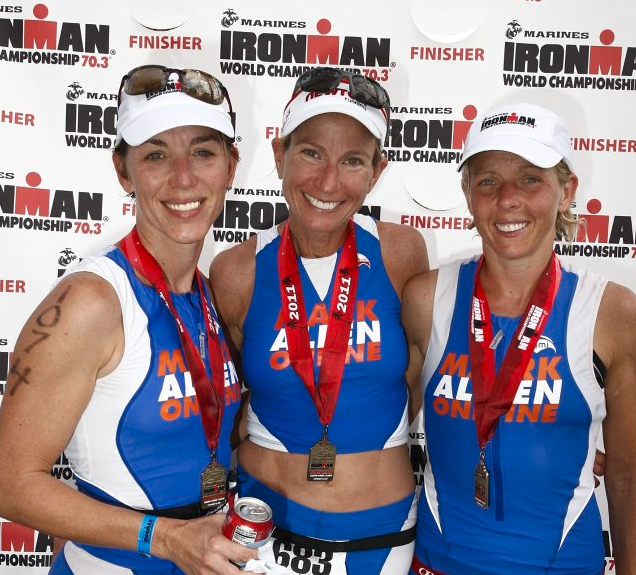
    Dawn English is a USA Triathlon, Level 1 Certified coach and has been coaching athletes since 2008.  She coaches beginners, experienced, juniors and Masters athletes.  Her training programs are structured around technique and basic cardiovascular fitness.  Personally, she has been competing in triathlons since 1999 and has done over 60 triathlons including 12 Half Ironmans (PR 4.57) and Ironman Texas in 2011 (11:50.01).  She is a two time 70.3 World Championship Qualifier and a 2012 USA Triathlon All American.  She has organized newbie youth and adult triathlon clinics for the community in conjunction with the Corpus Christi Triathlon Club for the last 4 years.  and has an undergraduate degree in Communications and a Masters in Public Administration. 

    Dawn has 2 Elementary aged children and is a Navy Spouse.To contact Dawn English:
    Equilibrium: Triathlon Coaching for Real Life
    equilibriumcoaching@yahoo.com
    (361) 658-9331

  6. Different Names For Sugar


    Barley Malt                                              Sugar Alcohols:

    Cornstarch                                              Carbitol

    Corn Syrup                                              Dulcitol

    Dextrose                                                  Erythritol

    Disaccharide                                          Lactitol

    Fructose                                                 Maltitol

    Galatactose                                           Mannitol

    Glucose                                                   Sorbitol

    Glucose Polymers                               Xylitol

    High Fructose Corn Syrup

    Honey

    Hydrogenated Starch Hydrolysates

    Lactose

    Levulose

    Maltodextrin

    Monosaccharide

    Sorghum Syrup

    Sucrose


  7. Ice or Heat?

    Ice or Heat?
    Should you use Ice or Heat for Pain and Inflammation?

    By Lisa Wright, CFT-LCI

    The following guidelines may help you sort it out.

    Acute and Chronic Pain
    There are two basic types of athletic injuries: acute and chronic.

    Acute Pain is of rapid onset and short-lived.
    Chronic Pain develops slowly and is persistent and long-lasting.

    Acute and Chronic Injuries
    Acute injuries are sudden, sharp, traumatic injuries that occur immediately (or within hours) and cause pain (possibly severe pain). Most often acute injuries result from some sort of impact or trauma such as a fall, sprain, or collision and it’s pretty obvious what caused the injury.

    Acute injuries also cause common signs and symptoms of injury such as pain, tenderness, redness, skin that is warm to the touch, swelling and inflammation. If you have swelling, you have an acute injury.

    Chronic injuries, on the other hand, can be subtle and slow to develop. They sometimes come and go, and may cause dull pain or soreness. They are often the result of overuse, but sometimes develop when an acute injury is not properly treated and doesn’t heal.

    Cold therapy with Ice
    Cold therapy with ice is the best immediate treatment for acute injuries because it reduces swelling and pain. Ice is a vaso-constrictor (it causes the blood vessels to narrow) and it limits internal bleeding at the injury site.

    To ice an injury, wrap ice in a thin towel and place it on the affected area for 10 minutes at a time. Allow the skin temperature to return to normal before icing a second or third time. You can ice an acute injury several times a day for up to three days.

    Cold therapy is also helpful in treating some overuse injuries or chronic pain. A person who has chronic knee pain that increases after running may want to ice the injured area after each run to reduce or prevent inflammation.

    The best way to ice an injury is with a high quality ice pack that conforms to the body part being iced. You can also get good results from a bag of frozen peas, an ice massage with water frozen in a paper cup (peel the cup down as the ice melts) or a bag of ice.

    Heat Therapy
    Heat is generally used for chronic injuries or injuries that have no inflammation or swelling. Sore, stiff, nagging muscle or joint pain is ideal for the use of heat therapy. Heat therapy may be used before exercise to increase the elasticity of joint connective tissues and to stimulate blood flow. Heat can also help relax tight muscles or muscle spasms. Don’t apply heat after exercise. After a workout, ice is the better choice on a chronic injury.

    Because heat increases circulation and raises skin temperature, you should not apply heat to acute injuries or injuries that show signs of inflammation. Safely apply heat to an injury 15 to 20 minutes at a time and use enough layers between your skin and the heating source to prevent burns.

    Moist heat is best, try using a hot wet towel.  Never leave heating pads on for more than 20 minutes at a time or while sleeping.

    Because some injuries can be serious, you should see your doctor if your injury does not improve (or gets worse) within 48 hours.

    Source: Sports Medicine

  8. Top 10 Motivational Quotes

    We recently posted a poll asking for feedback on the best motivational quotes.  Here are the top 10:

    1.  Only exercise the body you want to keep

    2. Blessed are the flexible, for they shall not be bent out of shape

    3.  Nike’s “Just Do It”

    4.  Pain is weakness leaving the body

    5.  Does it hurt more to do it or not to do it?

    6.  Once again, skill and daring have overcome fear and anxiety!

    7.  You can’t make a mistake when you are trying something new

    8. If it’s important to you, you will find a way.  If not you will find an excuse.

    9.  Don’t think, act.

  9. Lemon Pancakes

    Healthy and Delicious – Who Knew?!

    By Marcia Keener-CPT-ACSM, Wellcoach

    Many of my clients have the mistaken idea that healthy eating cannot possibly be tasty, and certainly not delicious.  However, Eating for Life by Bill Phillips contains recipes which offer evidence to the contrary.  My husband, Rick and I enjoy a leisurely weekend breakfast together each week.  We wanted a breakfast that we could look forward to for both taste and nutrition that could support a busy weekend day.  We wanted a balance of enjoyment and good health.  For the past several years (No, I did not mean months.) we have been enjoying The Golden Pancakes recipe found in that particular cookbook.  Not only do we prepare these pancakes for ourselves but any weekend guests enjoy them as well.  We have used the original recipe and have experimented with new flavors. Below is our favorite version:


    Lemon Golden Pancakes

    1 C uncooked whole grain rolled oats (not instant)

    6 egg whites (@ ¾ c)

    1 C fat free cottage cheese

    2 tsp vanilla (we use Mexican vanilla)

    1 tsp nutmeg

    6 packets Splenda

    Juice and zest of one lemon

    1 tsp of sea salt


    1. Lightly coat a nonstick skillet or griddle with cooking spray; place over medium heat.  If using an electric griddle, use 300 degrees/medium high.
    2. In a blender, combine oats, egg whites, cottage cheese, vanilla, nutmeg, sweetener, lemon juice, and lemon zest.  Blend on medium speed until smooth, about 1 minute.
    3. Pour batter about ¼ cup at a time, onto hot skillet. Cook pancakes until bubbly on top and dry around edges, about 3 minutes, about 3 minutes.  Turn and cook other side until golden brown, about 2 more minutes.
    4. While pancakes are cooking, microwave maples syrup and blueberries until warm.
    5. Place a serving of pancakes on warm plate.  Top with warm maple syrup and/or warm blueberries and non-fat whipped topping and a small amount of walnut pieces.  Enjoy!!!!!

    Toppings:


    ¼ cup per serving of frozen blueberries heated (Use your preference on berries)

    Maple Syrup sweetened with Splenda

    Non-fat whipped topping

    Sprinkling of walnuts


    Serving Size and nutritional value:

    Recipe makes approximately 8 pancakes

    Servings: 2

    Nutritional Value per serving:  Approximately 4 pancakes

    Protein:     26 grams

    Carbs:          19.5 grams

    Fat:               1.5 grams

    Calories:    205


Your Personal Best Location
Your Personal Best Training Studio
Doddridge Plaza
3765 S. Alameda, Ste 102
Corpus Christi, TX 78411
(361) 857-5087 info@ypbtrainingstudio.com